
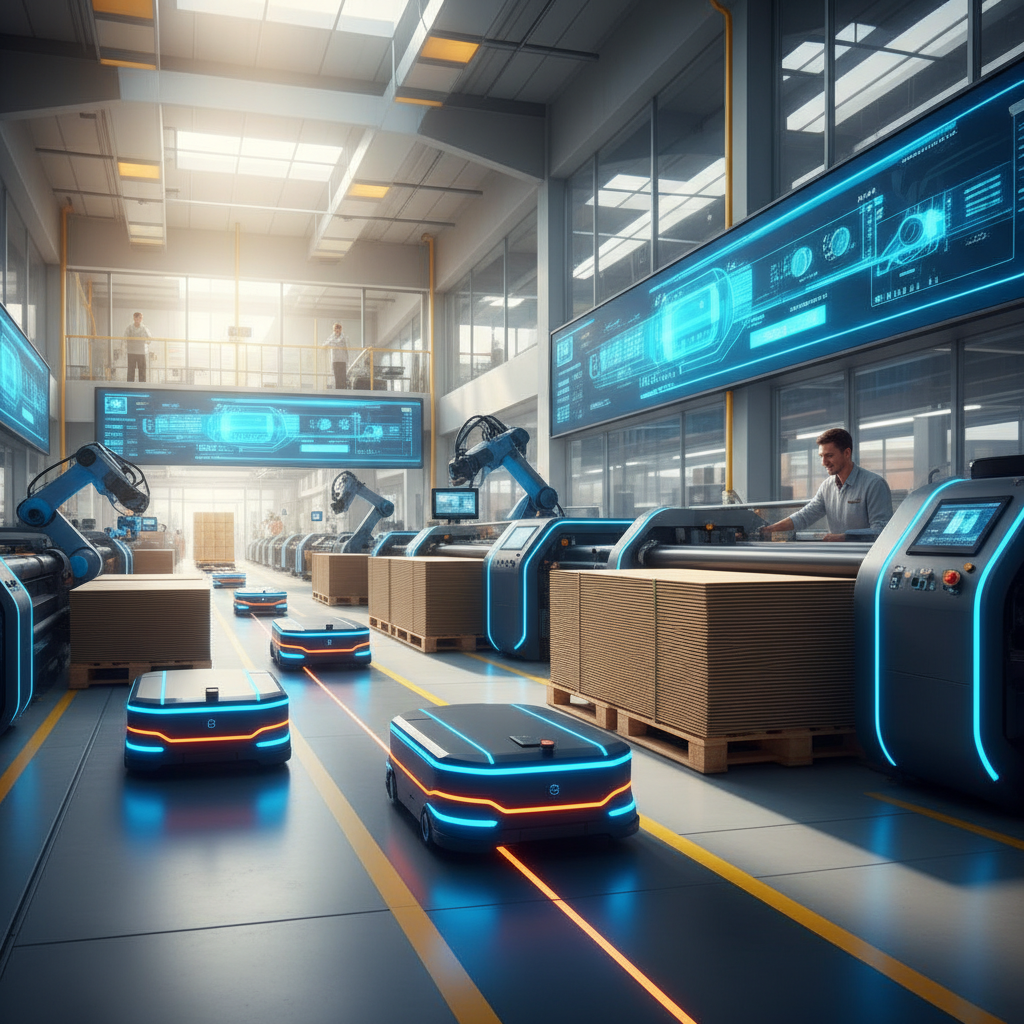
Revolutionizing the Corrugator Take-Off: Global AMR Trends in 2024-2025
An in-depth analysis of how Autonomous Mobile Robots (AMRs) are transforming the dry end of corrugator plants globally. The article highlights key 2024-2025 trends such as AI integration, heavy payload capacities, omnidirectional mobility, and seamless WIP logistics that are driving efficiency and safety in the packaging industry.
Revolutionizing the Corrugator Take-Off: Global AMR Trends in 2024-2025
The global paper and corrugated packaging industry is currently navigating a period of rapid evolution, driven by the escalating demands of e-commerce, shifting consumer preferences toward sustainable materials, and a relentless pressure to optimize production efficiency. At the heart of any corrugated box plant lies the corrugator itself, a massive machine that produces continuous webs of board. However, the true bottleneck in modern facilities often occurs at the dry end, specifically the corrugator take-off. This is the critical juncture where freshly cut and stacked corrugated boards must be rapidly transported to Work-in-Process (WIP) storage or directly to converting lines. In 2024 and expanding significantly throughout 2025, Autonomous Mobile Robots (AMRs) have emerged as the definitive solution to this logistical challenge, transforming intralogistics on a global scale.
The Paradigm Shift: From Manual Handling and AGVs to AMRs
Historically, the transfer of corrugated board stacks from the take-off conveyor to storage areas relied heavily on manual labor operating forklifts, or at best, Automated Guided Vehicles (AGVs). While AGVs provided a level of automation, they are inherently rigid, requiring fixed infrastructure such as magnetic strips, wires, or painted lines to navigate. In the dynamic and often chaotic environment of a corrugated plant, where debris, dropped sheets, or moving personnel are common, a blocked AGV path results in immediate production downtime. The fundamental trend defining 2024 and 2025 is the mass migration toward AMRs. Unlike their predecessors, AMRs utilize advanced Simultaneous Localization and Mapping (SLAM) technology. They do not follow fixed tracks; instead, they understand the layout of the facility and dynamically reroute themselves around obstacles, ensuring a continuous flow of materials from the corrugator take-off without interrupting the high-speed output of the dry end.
Key Technological Trends in 2024-2025
As we analyze the current state of the global corrugated industry, several distinct technical trends characterize the newest generation of AMRs deployed at the corrugator take-off.
- Heavy-Duty Payload Capacities: Stacks of corrugated board are incredibly heavy and bulky, often exceeding two tons. The latest AMRs introduced in 2024 feature specialized high-capacity chassis and customized roller decks that interface seamlessly with the take-off stackers, allowing for the autonomous transfer of massive multi-pallet loads in a single trip.
- AI-Driven Navigation and Digital Twins: Artificial Intelligence is now heavily integrated into fleet management software. By leveraging digital twins—virtual replicas of the factory floor—plant managers can simulate and optimize AMR routing in real-time. In 2025, predictive algorithms allow AMR fleets to anticipate corrugator order changes, positioning themselves at the take-off exactly when a new batch is ready.
- Seamless Integration with WIP Systems: Modern AMRs do not operate in a vacuum. They are fully integrated with the plant's Manufacturing Execution System (MES) and Work-in-Process (WIP) software. This ensures that the robot knows exactly which converting machine (such as a casemaker or die-cutter) requires the board next, eliminating intermediate storage times and reducing WIP inventory.
- Advanced Safety and Omnidirectional Mobility: Factory floors are busy. To protect human workers and prevent damage to the fragile edges of corrugated sheets, 2025 AMR models are equipped with 360-degree LiDAR, 3D vision cameras, and ultrasonic sensors. Furthermore, omnidirectional wheels allow these robots to move sideways and rotate in place, navigating the tightest aisles of the dry end with ease.
Impact on the Global Paper and Packaging Industry
The macroeconomic factors of the past few years have made labor shortages a severe global issue. Skilled forklift operators are difficult to recruit and retain. By automating the corrugator take-off with AMRs, packaging companies are reallocating their workforce to higher-value, safer tasks. Furthermore, manual forklift handling is a leading cause of product damage; forks often crush the bottom layers of corrugated stacks, resulting in significant waste before the board even reaches the converting stage. The smooth, precise handling of AMRs virtually eliminates this damage, directly improving the bottom line. The return on investment (ROI) for AMR fleets in large corrugated plants has dropped from over three years to less than 18 months, spurring aggressive global adoption from North America to Asia-Pacific.
Looking Ahead
As we move deeper into 2025, the adoption of AMRs in the paper packaging sector is no longer just a competitive advantage; it is becoming an operational necessity. The integration of these intelligent robots at the corrugator take-off is setting the foundation for the ultimate goal of the industry: the fully autonomous 'lights-out' corrugated plant. For industry professionals, understanding and investing in this agile automation will dictate market leadership for the next decade.
Enjoying this article?
Register free to save and share.